
Is Your Company Ready for AI Agents?
The conseil.dev team
June 7, 2026
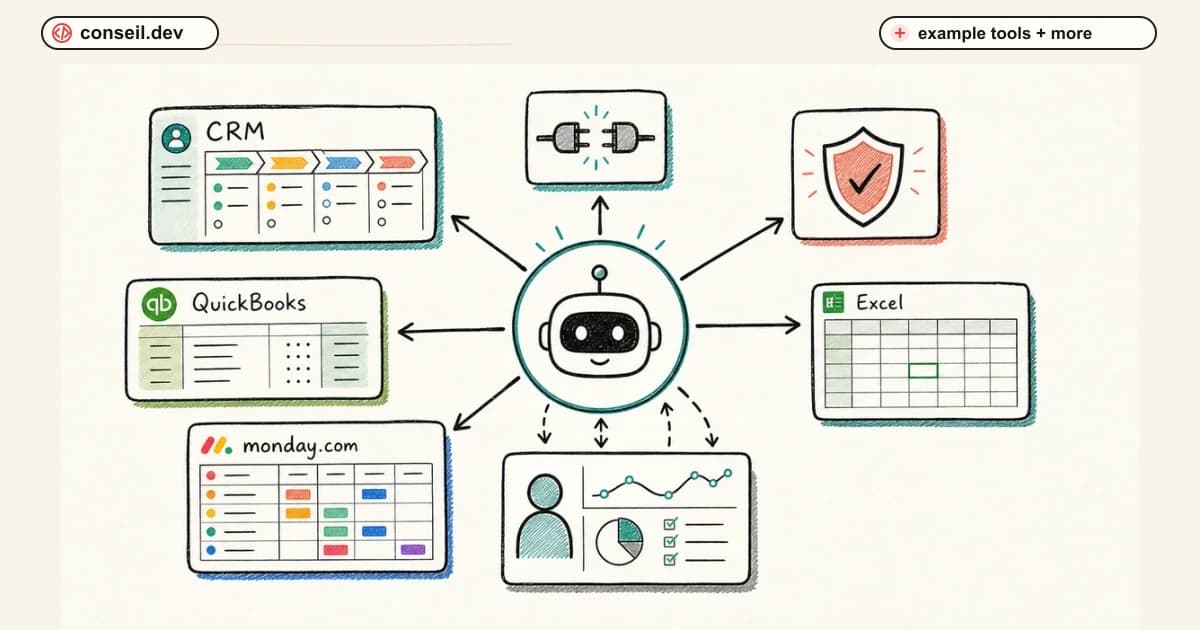
The move from conversational AI (chatbots and copilots that read and generate text) to agentic AI is the biggest enterprise technology shift of the mid-2020s.
The difference is not subtle. A chatbot answers a question. An agent takes action: it updates a database, sends an email, issues a refund, runs code, and chains those steps together to finish a job with little human involvement.
That single change, from generating to acting, is why agent readiness is a different problem than GenAI readiness. Traditional GenAI mostly needs clean data and decent prompting. Agents need reliable APIs, strict security guardrails, and operational frameworks that did not exist two years ago. You can license the smartest model on the market, but if your systems cannot securely let an agent act inside them, the agent is paralyzed.
So before you deploy anything autonomous, the real question is: is your company actually ready? Readiness comes down to four pillars.
The four pillars of AI agent readiness
1. Technical and infrastructure: the "hands"
Agents do their work through tools and integrations. If your software only responds to a human clicking through a user interface, an agent has nothing to grab onto.
- API ecosystem. Your core systems (CRM, ERP, HR) need well-documented, predictable APIs. Legacy, monolithic platforms that only expose a UI are the single biggest blocker to agent deployment.
- Stateful memory. Real tasks are not instant. An agent has to start a job, pause two days for a human approval, then resume without losing its place. That requires infrastructure for long-term memory (vector or knowledge-graph databases) and short-term context.
- Smart compute routing. Mature setups send routine tasks to small, cheap models and escalate only the hard reasoning to large frontier models. Routing everything to the biggest model is slow and expensive.
2. Security, governance, and risk: the "guardrails"
Because agents act on their own, security is the number-one reason enterprise rollouts stall. You are handing software the keys to your company.
- Identity for non-humans. The current standard is to treat each agent like a digital employee: its own service account, with least-privilege, role-based access. An HR agent must not be able to query the financial ledger. Ever.
- Blast-radius limits. Assume an agent will eventually hallucinate, loop, or misfire. Contain the damage in advance with API rate limits, hard budget caps on compute, and execution sandboxes.
- Traceability. A whole category, "AgentOps," exists to record an agent's chain of reasoning and every API call it makes. When something goes wrong, compliance needs to reconstruct exactly why the agent decided what it did.
3. Data and process: the "brain"
- Connected knowledge, not just documents. Basic retrieval (RAG) answers questions. Agents often need to reason across relationships: this entity connects to that contract connects to this obligation. Knowledge graphs let an agent follow those multi-hop links before it acts.
- Documented procedures. Agents struggle with vague, undocumented work. The companies that are most ready are the ones with clearly mapped standard operating procedures, because those procedures translate almost directly into agent logic and constraints.
4. Organizational and cultural: the "human layer"
- From doers to managers. People stop executing every task and start delegating, reviewing, and auditing the work their agents do. That is a real skill shift, and it needs real training.
- Human-on-the-loop, not in-the-loop. "In the loop" means a person clicks approve at every step, which recreates the bottleneck you were trying to remove. "On the loop" means agents run autonomously while a person watches an oversight dashboard and steps in only when something is flagged. The second model is what makes agents worth deploying.
What's changing right now
If you want to track where this is heading, two shifts matter most.
Multi-agent systems are replacing the "do-everything" agent. The industry tried to build one giant agent to run the business. It did not work. The pattern now is orchestration: a researcher agent gathers data, hands it to a financial agent to run numbers, a risk agent challenges the result, and an output agent writes the report. Each agent is narrow, testable, and replaceable.
Agentic automation is eating traditional RPA. Old robotic process automation relies on rigid scripts: if a button moves on a web page, the bot breaks. Modern agents use vision and reasoning to navigate software the way a person would, following the intent of a task instead of memorizing pixel positions. They also recover better: when an API call fails, a capable agent reads the error, rewrites its request, and tries again instead of crashing.
How to assess your readiness this week
You do not need a six-month study to know where you stand. Run three quick tests.
- The API audit. Map your core software. Do those applications have modern, documented APIs, or does your team interact with them only through legacy screens? If it is the latter, you are not agent-ready yet, and that is the first thing to fix.
- The least-privilege test. Can your IT security grant a digital agent narrow, restricted access to one specific tool or dataset, rather than blanket admin rights? If the only option is "all or nothing," your governance is not ready.
- The high-friction process test. Find the workflows where people spend their time moving data (copying, formatting, routing) instead of making decisions. Map those into clear steps. They are your first realistic candidates for agents.
The bottom line
AI agent readiness is an IT modernization and governance challenge, not just an AI challenge. The model is rarely the limiting factor. The limiting factors are whether your systems can be safely acted upon, whether your security can contain an autonomous actor, and whether your processes are clear enough to hand off.
Companies that treat this as plumbing and guardrails, not as a model-shopping exercise, are the ones that will deploy agents safely while everyone else is still running pilots. You can see how we scope and ship those projects before committing to anything.
Want to know where your company actually stands? We start every engagement with a 30-minute discovery call to assess your APIs, security posture, and best first use cases. No commitment, no jargon.