
How LLM Wiki Helps Teams Work From Shared Memory
The conseil.dev team
June 4, 2026
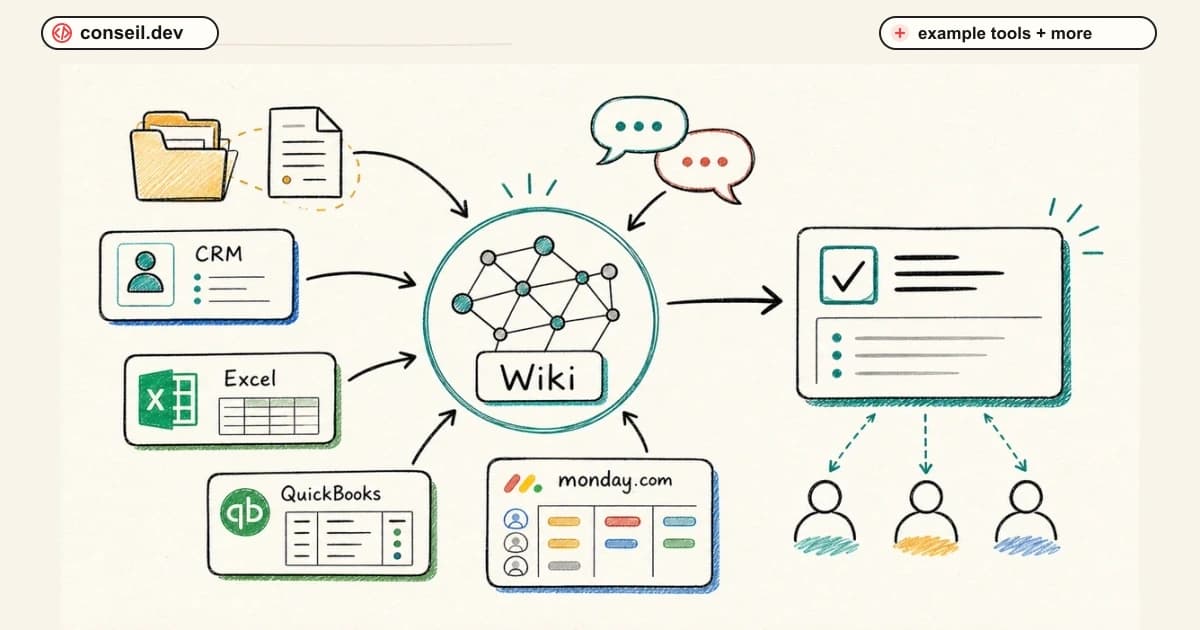
Every company has knowledge that matters but does not quite live anywhere.
It is in email threads, policy notes, client calls, spreadsheets, onboarding docs, meeting transcripts, and the heads of a few people who have been around long enough to remember why a decision was made. Search helps find some of it. Chat tools help ask questions about it. But neither one is enough when the answer needs evidence, history, ownership, and a clear path back to the source.
We built LLM Wiki for that gap. It turns scattered information into a private, auditable knowledge base that people and AI tools can use together. The goal is not to replace documents. The goal is to make documents explain themselves.
What LLM Wiki Is
LLM Wiki is a private knowledge layer — a system we deploy inside your infrastructure that ingests your documents, extracts source-backed claims, and gives your team and your AI tools a shared memory they can actually trust.
Under the hood, it uses the same production patterns we have deployed for regulated clients: a retrieval-augmented generation (RAG) pipeline, local embedding and vector storage, role-based access control at the query level, and source citations on every answer.
We first built this pattern for a Montreal wealth management firm that needed AI-powered document synthesis without exposing client data to public APIs. Quebec's Law 25 and federal PIPEDA made it illegal to send sensitive financial data to third-party model providers. So we deployed the entire stack — open-weight LLM, RAG pipeline, vector database — inside their Canadian VPC. Zero data leaves the infrastructure. Every answer comes with a citation trail.
That deployment proved the model: 12 hours per week reclaimed per advisor, 100% regulatory compliance, and predictable monthly costs instead of volatile per-token billing.
LLM Wiki takes that same architecture and packages it as a repeatable product — one we can deploy for any team that needs to work from shared, verifiable knowledge.
How It Works
- Ingest — LLM Wiki indexes your documents: emails, PDFs, memos, transcripts, CRM records, policy notes, working files. Source materials are preserved exactly as they are.
- Extract — The system identifies claims, relationships, dates, decisions, and source references. Each fact is tied to the document it came from.
- Surface — Your team (or your AI tools) can query the knowledge base and get answers with citations. Every response links back to the original source so you can verify it.
- Control — Access is scoped by role. The system only returns information the user is authorized to see. Sensitive data stays local — no external API calls, no cloud-only memory.
Below are five examples of how this helps different businesses, starting with the one we work with most.
1. Accounting Firms: From Client Files to Reliable Answers
An accounting office handles a constant stream of client-specific facts: filing deadlines, entity structures, tax elections, prior-year adjustments, advisory notes, payroll details, and decisions made during busy season.
The problem is not that the information is missing. It is that it is fragmented.
A partner may remember that a client changed its reporting approach two years ago. A manager may know where the supporting email is. A staff accountant may only see the current workpaper and not the history behind it. When someone asks, "Why are we treating this client this way?", the answer can require digging through old files and asking three people.
With LLM Wiki, the office can create a local knowledge base for each client or practice area. Source materials remain preserved — emails, notes, memos, transcripts, and working documents are stored as evidence. The system extracts claims, relationships, dates, and source references into readable, searchable pages.
For a senior accountant, the impact is direct:
- Client context becomes easier to review before a call.
- New staff can understand why a decision exists, not only what the decision is.
- Risky or uncertain facts can be flagged instead of silently reused.
- AI assistants can answer with citations instead of loose summaries.
- The firm keeps sensitive knowledge local instead of pushing it into a cloud-only system.
This builds directly on the document processing and automation work we deliver for accounting firms. LLM Wiki is the knowledge layer that makes those automations smarter over time — receipts, bank rec, and client follow-ups all get better when the AI understands your client history.
2. Software Companies: Keeping Product Decisions Traceable
Software teams move quickly. Roadmaps change. Architecture decisions are made in design docs, Slack threads, pull requests, customer escalations, and incident reviews.
Without a shared memory layer, teams often repeat debates. A new engineer asks why a system works a certain way, and the answer is, "There was a reason, but the context is buried."
LLM Wiki helps by turning design decisions, incidents, and release notes into a navigable knowledge structure. It can connect a feature to the customer problem that caused it, the technical decision behind it, the risks accepted at the time, and the follow-up work that remains.
The value is not just search. It is continuity.
Leaders can see what the team believes, where the evidence came from, and which facts are stale. Engineers can onboard faster. Product managers can compile context before planning. AI coding tools can retrieve grounded project memory instead of guessing from the current codebase alone.
3. Legal Services Firms: Preserving Matter Context
Legal teams often work from dense matter histories: research notes, precedents, filings, correspondence, timelines, jurisdiction-specific rules, and client instructions.
The challenge is that context changes over time. A fact may be true for one matter, false for another, or valid only before a later filing or court decision.
LLM Wiki is useful here because it treats knowledge as temporal and source-backed. A matter page can show what is known, when it was observed, what source supports it, and whether another source disputes it.
For a firm, this supports better internal handoffs. An associate joining a matter can review the current state without losing the reasoning trail. A partner can inspect provenance before relying on a summary. A knowledge manager can identify reusable research while still preserving matter boundaries and access rules.
This pairs well with the intake and document automation we build for law firms — LLM Wiki provides the institutional memory that makes those workflows reliable across matters and across team changes.
4. Healthcare Operations: Making Procedures Easier to Trust
Healthcare operations teams maintain policies, vendor instructions, audit requirements, onboarding guides, escalation flows, and compliance procedures.
The common failure mode is drift. A process changes, but the old version still appears in a document. A team follows a checklist that was correct last quarter. A new employee asks an AI assistant and gets an answer without knowing which policy version it came from.
LLM Wiki can organize operational knowledge around source-backed claims and update history. A procedure page can show which document introduced the rule, what changed recently, and which steps are still under review.
This helps leaders reduce ambiguity. Instead of asking whether the team has "a document somewhere," they can ask whether the current procedure has validated sources, unresolved disputes, and stale references.
5. Manufacturing: Connecting Floor Knowledge to Business Memory
Manufacturing companies carry knowledge across shift notes, maintenance logs, supplier updates, quality reports, equipment manuals, and engineering changes.
This information is operationally valuable, but it often lives in separate systems. A recurring equipment issue may be visible in maintenance notes, connected to a supplier change, and relevant to a customer quality complaint — yet no single document tells that story.
LLM Wiki can link these records into a readable map. Equipment pages can connect to incidents, fixes, parts, vendors, inspection notes, and unresolved questions. Claims can be tied back to logs and reports.
The result is a more durable operating memory. Teams can see patterns faster, prepare better handoffs, and ask AI tools for context that includes evidence rather than anecdotes.
Why It Matters
The real promise of AI inside companies is not just faster writing or smarter chat. It is better use of institutional knowledge.
But that only works if the knowledge layer is trustworthy. A company needs to know:
- Where an answer came from.
- Whether the source is reliable.
- Whether the fact is current.
- Whether another source disagrees.
- Whether the AI is answering from evidence or filling gaps.
LLM Wiki is designed around those questions. It keeps raw sources intact, extracts claims with provenance, writes human-readable pages, and gives both people and AI tools a safer way to work from shared memory.
For an accounting office, that might mean fewer repeated searches through client history. For a software company, fewer repeated architecture debates. For a legal firm, cleaner matter handoffs. For a healthcare operations group, more reliable procedures. For a manufacturer, faster pattern recognition across logs and reports.
Different industries have different documents. They share the same deeper problem: important knowledge gets scattered faster than teams can organize it.
LLM Wiki helps turn that scattered knowledge into something the company can inspect, trust, and reuse.
Want to see how LLM Wiki could work for your team? We scope every deployment as a fixed-fee project — discovery call, process mapping, production deployment, and handover.