
Accounting firms: cutting bank reconciliation time by 3x with AI
The conseil.dev team
May 1, 2026
The real cost of manual reconciliation
In an average accounting firm (5-20 people), monthly bank reconciliation represents 35 to 45% of technician time. Not because it is hard. Because it is repetitive, high-volume, and full of small awkward cases: Interac payments with no name, grouped deposits, off-schedule checks, transfers that arrive in two parts.
Payroll gets done. GST-QST gets calculated. But your junior technician's effective hourly rate collapses to $45/hr when they are billed at $80/hr.
What QuickBooks and Acomba already do (and why it is not enough)
QuickBooks and Acomba both ship automatic matching rules. That handles 60-70% of transactions. Not bad — but it is the remaining 30-40% that eat the hours.
Those 30-40% are:
- Ambiguous descriptions: "INTERAC PAYMENT 4523" with no context.
- Grouped payments: three client invoices paid in a single transfer.
- Uncategorized bank fees: every bank names them differently.
- Post-dated checks that jump a month.
- Refunds / reversals that rule-based systems miss.
This is exactly what a well-configured LLM does well. It reads context, it looks at the client's historical patterns, and it proposes a category + invoice match with a confidence score.
The shape of a reconciliation AI pilot
For a firm running QuickBooks Online (or Acomba) + Hubdoc or Ledgible for receipts:
- Automatic bank transaction import (already in place for most clients).
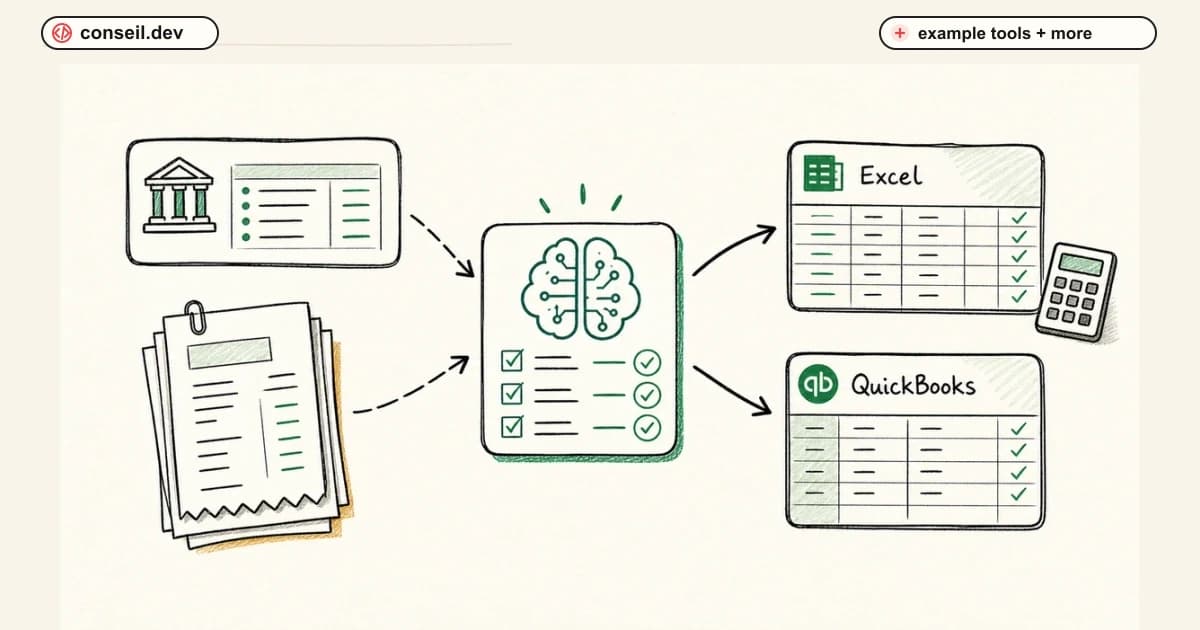
- AI pre-categorization layer. For every transaction not matched by rules, an LLM prompt with access to the client's general ledger, the last 12 months of similar transactions, and open invoices. Returns: proposed category, invoice match if applicable, confidence score.
- Confidence threshold. Above 90%: auto-reconciled. Between 70-90%: one-click validation for the technician. Below 70%: classic manual review.
- Per-client learning. The pilot remembers manual corrections and reuses them next month.
- Monthly dashboard. For each client: % automated, % quick-validated, % manual. You see where profitability climbs, month over month.
The numbers we see in the field
For an 8-technician firm with ~60 active clients:
- Before: 45% of time on reconciliation. About 650 hours/month across the firm.
- After 2 months of pilot: 55-65% of transactions auto-reconciled. Quick validation on 20-25%. Manual only on 10-15%.
- Time recovered: 250 to 350 hours/month.
At $80/hr billed, that is $20,000-$28,000/month of freed capacity. You use it to take on more clients, push into advisory, or simply stop burning your teams out in March.
Legitimate objections we hear
- "What about control?" The pilot changes nothing without validation below the confidence threshold. You keep the last signature.
- "Where does the client data live?" Inside QuickBooks / Acomba. The LLM receives the minimum necessary, with masked names if required. A self-hosted model is an option if it is a hard requirement.
- "We tried Dext / Hubdoc, it was not that magic." Correct. Dext does receipt capture very well, complex reconciliation poorly. We are not replacing Dext — we are closing the gap between Dext and QuickBooks.
What this changes for the managing partner
Today, the client conversation is monthly and often defensive: "why did it take so many hours this month?" After automation, the conversation becomes quarterly and strategic: KPIs, profitability, projections. That is where you move your value up — and your rates.
To test the idea on your firm
The AI Integration Project maps your processes, quantifies the gains, and ships a live pilot. Wired directly into QuickBooks or Acomba.
Or lighter: download the AI readiness checklist for accounting firms.