
Law firms: automating client intake with AI without breaking your Clio workflow
The conseil.dev team
April 29, 2026
The 2-hour hole no one puts on the P&L
In almost every 1-20 attorney firm we meet, the pattern is the same: between "lead received" and "matter open in Clio", about 2 hours of admin goes by per new client. A PDF form filled in by hand. A manual conflict check run across three Google searches and one internal tool. A retainer sent as an attachment. Two days of chase-ups before it comes back signed.
Multiply by 15-25 new files per month. That is 30 to 50 hours of admin that someone on your team is billing at $0/hr.
Why AI changes the economics — not just the tech
The firms we meet have usually tried ChatGPT. The verdict: "interesting, but it does not know our workflow." That is correct. A general-purpose tool does not know your Clio, does not know what a conflict check means in your practice, and does not fill a retainer in your template.
The automation that pays is the one that is wired into the stack you already run. No new app to adopt. Just the rails between your existing tools, with an LLM in the middle doing the repetitive work.
The typical shape of an intake AI pilot
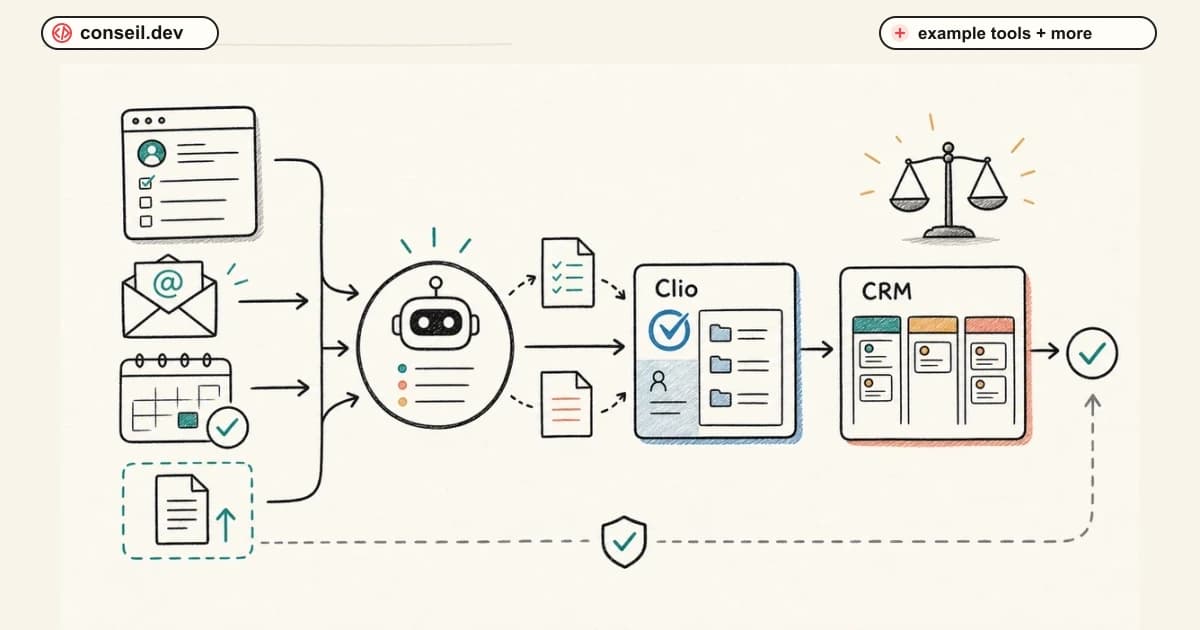
For a firm on Clio (or PracticePanther) + Gmail + Google Drive, the pilot is 5 steps:
- Public form (Typeform or Tally). Replaces the PDF. Fields are known in advance: matter type, parties, dates, free-text context.
- Automated conflict check. An LLM prompt compares named parties to your active matters in Clio via the API. Three signals: green (no conflict), yellow (partial match — human review), red (clear match — automatic decline).
- Matter opening in Clio. If green, the matter, client record, and custom fields are pre-populated automatically.
- Intake email + retainer link. A parameterized template goes out via Gmail, with a DocuSign (or equivalent) link for signature.
- Team notification. Slack or email to the responsible attorney.
Under 3 minutes end-to-end, with no human intervention unless the conflict check flags yellow.
What you have to accept
- Humans stay in the loop for yellow flags. Roughly 10-15% of new requests. That is by design, and it is what protects you from false positives.
- The first 2 months you audit everything. Like any system, AI makes errors at the start. The team reviews the first 50 matters opened by the pilot. After that, trust is earned.
- Your templates must be standardized. If every attorney has their own version of the retainer, automation breaks down. The mapping phase of the project solves this in 1-2 days.
The actual math for a 5-attorney firm
- 20 new matters/month × 2 hours of admin = 40 hours/month.
- Automated pilot: 10-15% of cases (yellow flag) still need 30 minutes of review. That is 1-1.5 hours/month of human time.
- Time recovered: 38 hours/month. At $150/hr paralegal loaded cost, $5,700/month.
The project pays for itself in 4-6 weeks. After that, it compounds.
What we will not sell you
- A new platform. Automation lives inside the tools you already use. You can cut it tomorrow, your data stays in Clio.
- A paralegal replacement. AI takes the most painful, least interesting slice of the work. Your paralegals do what they do best: nuance.
- A 6-month project. The pilot ships fast. If after the mapping phase you decide it is not worth it, we stop — no commitment.
If you want to test the idea on your firm
The AI Integration Project identifies the 3 most profitable processes to automate in your firm — and ships a live pilot.
Or start lighter: download the AI readiness checklist for law firms.